

At Project Phoenix, we’re constantly thinking about how the UK animal freedom movement can make large leaps forward, and how we can do it in a way that brings the majority of the public along with us. Like many in the movement, we see ending factory farming as a huge and necessary milestone towards animal freedom. We also believe we need factory farming at the forefront of people’s minds as an urgent moral issue if we are to stand a chance of building political pressure around ending it.
But where does the British public currently stand on factory farming? Is it wary of bold change? Is it open to reducing eating animals to make ending factory farming a possibility? We wanted to find out by running an in-depth public opinion study. Some insights support other research findings, and we also uncovered some surprising insights that could empower our movement’s campaigning…
1. The UK public are already convinced that factory farming is wrong, regardless of whether suffering is reduced.
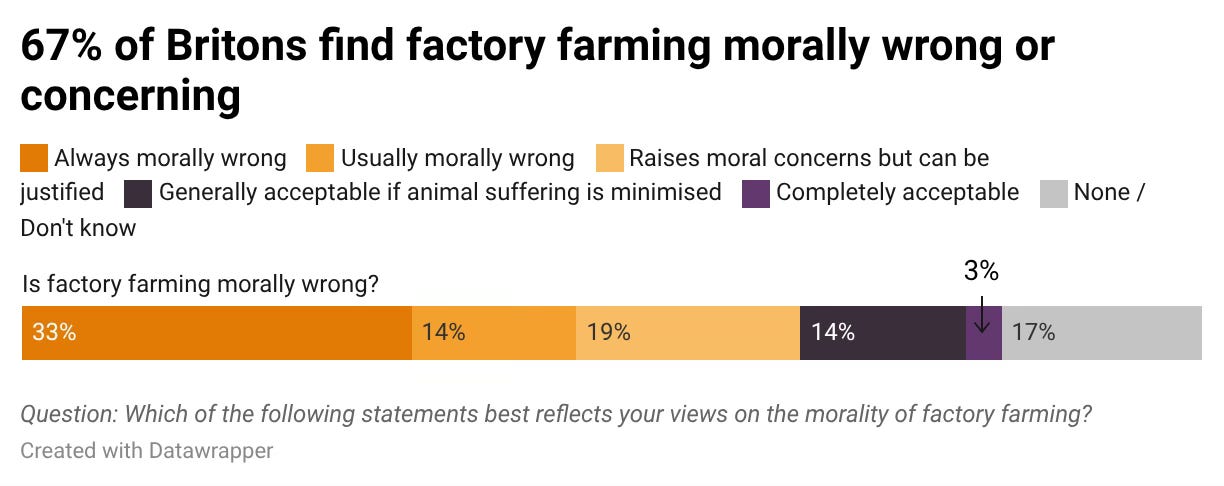
Our movement is already in a strong position on this issue, with the majority of the public with us. Most view factory farming as a moral issue, with a solid majority of UK adults (67%) saying factory farming is morally wrong or morally concerning. A particularly hopeful insight is that a third of UK adults (33%) say factory farming is always morally wrong. They represent the ‘unconditional’ group – people whose moral positions are more likely to persist over time and to survive counter-argument and industry pushback.
Only a small minority (14%) believe factory farming is acceptable if animal suffering is minimised, revealing that most people think animals being confined in factory farms is immoral, regardless of welfare standards. Only 3% of people think factory farming is completely acceptable. And those undecided on the morality of factory farming are also a small minority at just 17%, highlighting that most people have a moral opinion on the issue.
This is testament to how effective our movement has been in making factory farming visible and abhorrent.
2. Brits want factory farming ended – and sooner than we might think.
We found that the majority of Britons (54%) want factory farming ended. Almost a quarter (23%) want it ended as soon as possible, with another 30% wanting it phased out over a number of years.
Even 46% of heavy meat-eaters want factory farming ended or phased out, indicating that opposition to factory farming is largely seen as a moral position, not a dietary one.
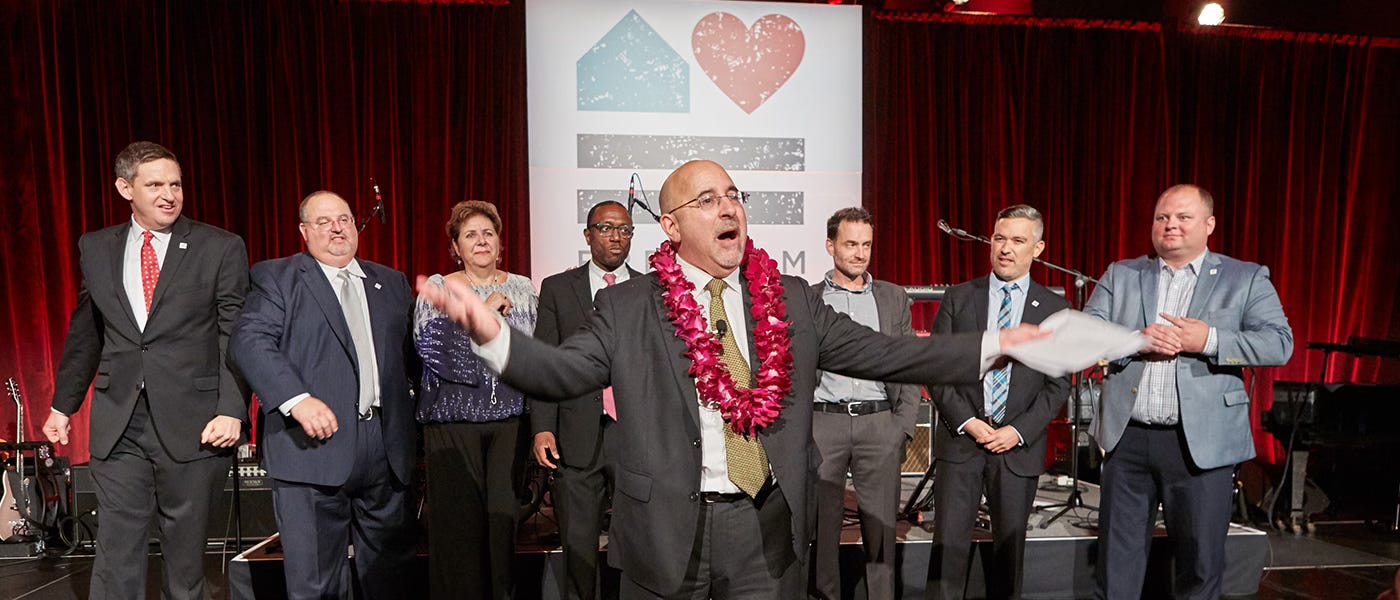
The animal freedom movement is already in a much stronger position than many other freedom movements on particular issues. For example, when Freedom to Marry started campaigning for marriage equality, the majority of Americans (60%) were opposed to same-sex marriage. One respected US pollster even told campaigners: “You’ll never see gay marriage in your lifetime.” (Spoiler: They achieved nationwide marriage equality in just over a decade after that comment.) Our movement has already done the hard slog of convincing most people factory farming needs to end. Our challenge now is turning that majority support into political and legal wins.
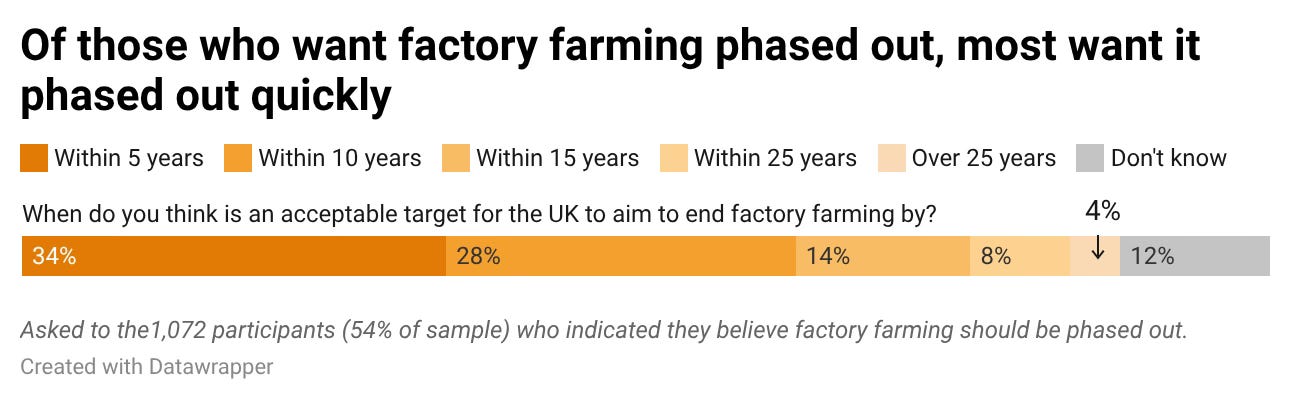
Among those who want factory farming gone, 76% would support ending it within 15 years or less – a timeframe that’s ambitious yet still viable with enough political will. Across the whole population, that’s 41% of all UK adults already backing a 15-year end date (or sooner), even after being reminded of the industry’s own argument that such change is slow and disruptive to supply chains.
This is where there is still work to do: convincing the public about the urgency and viability of ending factory farming.
These insights highlight that a bolder ask of ending factory farming seems to be more popular than a cautious one around improving it and minimising suffering. Calling on the UK government to set a dated phase-out plan isn’t seen as radical to many people. It’s something a lot of the British public are already in support of. And many organisations, like Project Slingshot, Animal Rising and Compassion in World Farming, are already calling for an end to factory farming by 2040.
3. People know what factory farming is – but not what animals trapped in the system are experiencing.
We asked participants to describe factory farming in their own words, and the categories that regularly came up were: industrialisation, cages, confinement, no outdoor access, and animals kept in cramped, intensive conditions.
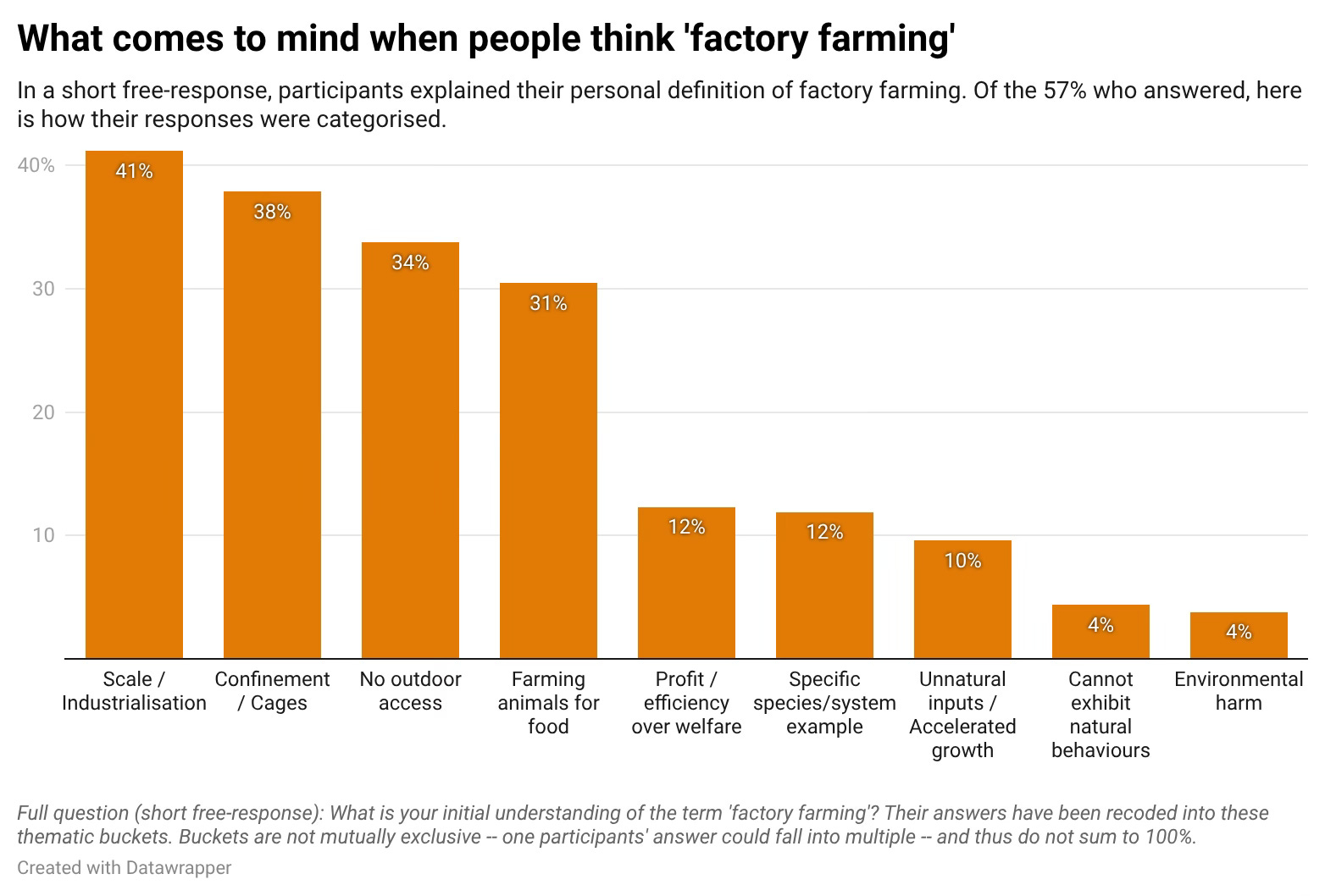
While most people understand what factory farming looks like, there seem to be important gaps in people’s mental models around what animals are experiencing inside them. There was virtually no mention of mutilations, families being separated or mental suffering. This gap is an opportunity for our movement to fill.
Mental suffering and animals’ inner lives may be our sharpest lever.
Across multiple studies some of the team at Project Phoenix were involved with, Animal Think Tank has found that highlighting psychological harm and animals’ inner lives is one of the most effective narrative interventions across different audience segments. The case we make shouldn’t only be about how many animals are confined, or how they’re confined – it’s also what effect their confinement has on them: the fear, the frustration, the depression, the denial of everything that makes a life worth living.
Communicating scale can tell people how big the problem is; communicating mental suffering – through stories of individuals – can show why it matters.
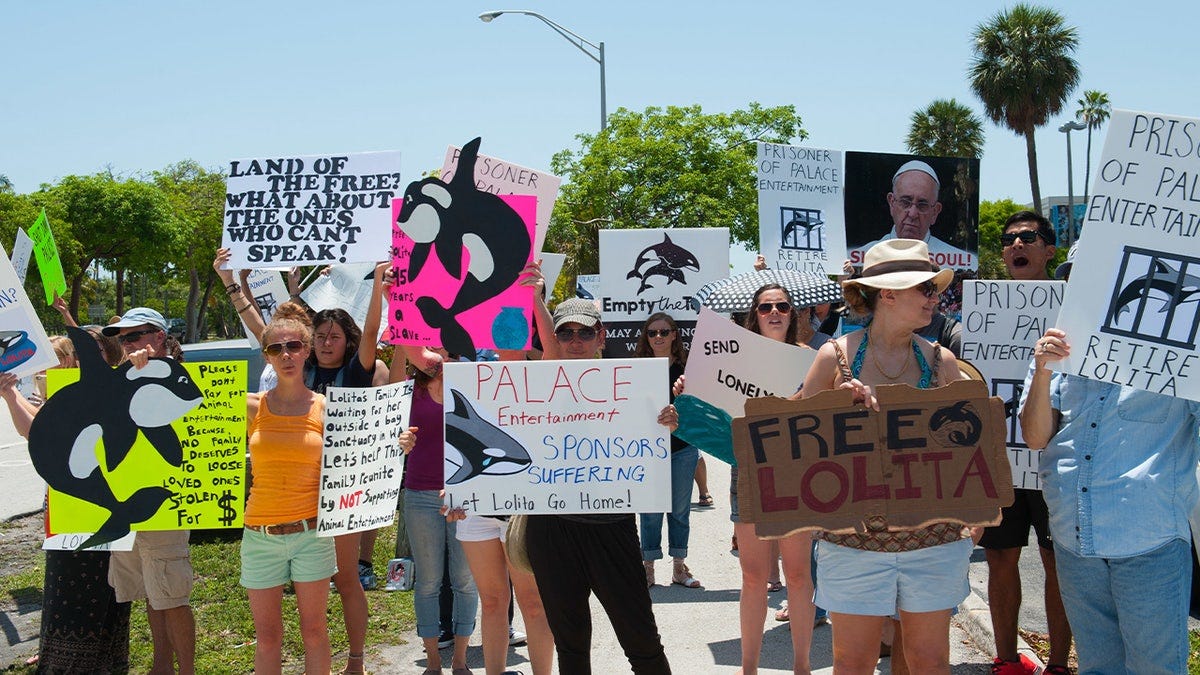
It was individual stories of mental suffering – like Tilikum and Lolita – that drove public debate about marine animals’ captivity, more than communicating facts could. And it’s a narrative strategy Animal Rising are using in their upcoming campaign, through the story of a mother pig, Luna.
4. The true scale of factory farming could be a double-edged sword.
There’s a second big gap in people’s mental models on this issue – how much of British farming is factory farming. And almost everybody underestimates it.
According to Compassion in World Farming, at least 85% of UK farmed animals are confined in factory farms (although many in the animal freedom movement think that’s a conservative figure, with the actual number much higher). Yet 96% of Britons either underestimate the scale of factory farming or have no idea.
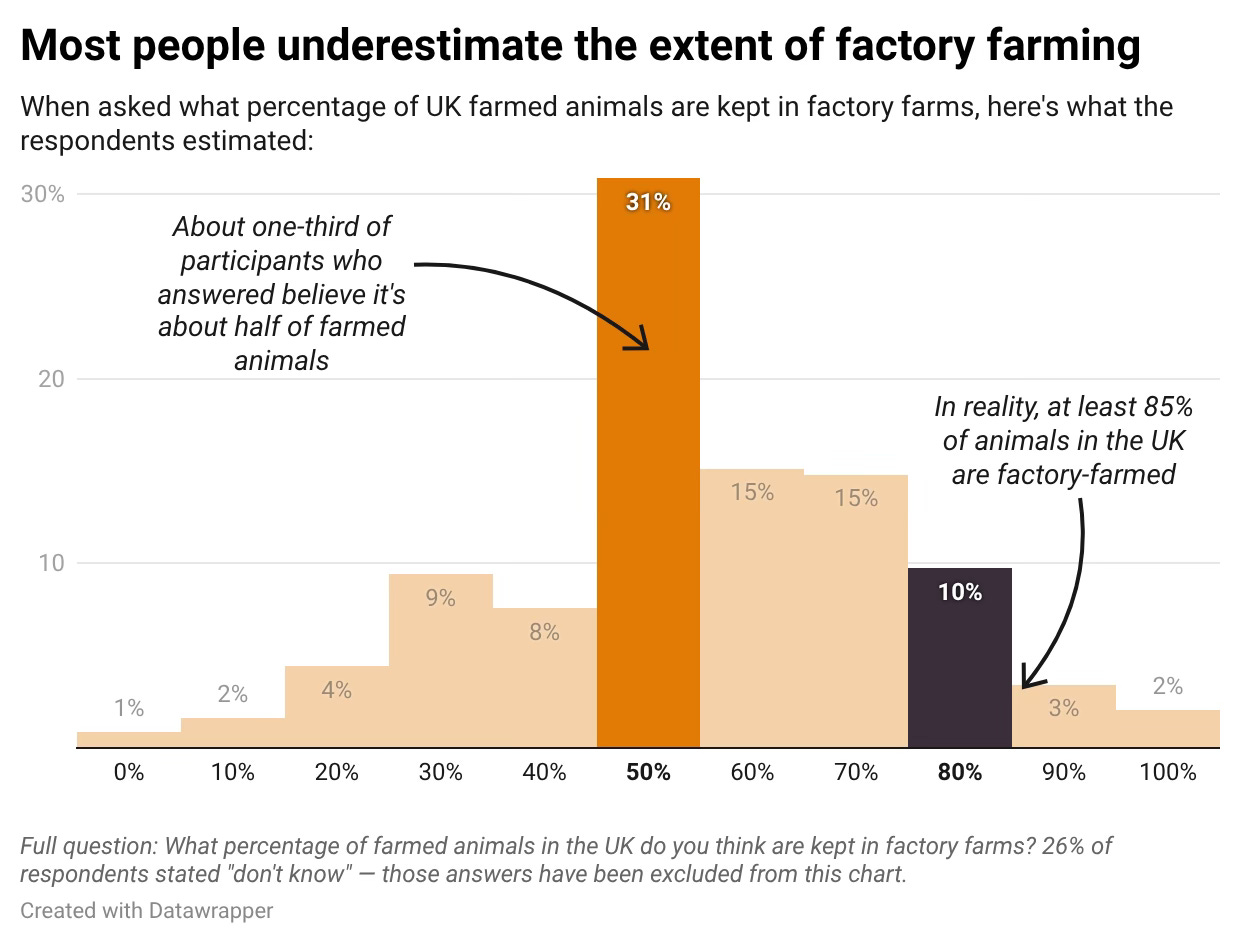
But if people back ending factory farming while believing it’s only half the system, does that support collapse when they learn it’s the overwhelming norm? There are two concerns entangled within this.
Firstly: does the support survive the correction, or is it soft support built on people not knowing the actual scale of factory farming? We aim to test this, but we think there’s reason to believe support to end factory farming could be durable. Why? Because support:
holds up among heavy meat-eaters who have no intention of changing their own diet;
survives being exposed to the industry’s own case for why change is slow;
and a third of the UK calls factory farming always morally wrong – a stance that doesn’t tend to erode when exposed to new facts.
Secondly: even if the support is genuine, does showing people the true scale make the problem feel too big to address? It’s a real risk, but there’s some evidence that can answer that. Research by Topos also found most Americans underestimate how pervasive factory farms are. They found a figure like ‘90%’ is effective because it’s high enough to break the belief that individuals can opt out through their own shopping choices, but not so high that it tips people into feeling the problem is too vast to fix. They found communicating a figure of over 90% did provoke futility, but a figure of 90% seems to communicate urgency with a sense that change is still possible.
Exposing the scale of factory farming could strengthen people’s desire for it to end, rather than weaken it (as early responses to Project Slingshot also indicate). It could help shatter the pastoral myth the industry clings to and show factory farming as the machine that it is, without driving people into a sense that “nothing can be done”. Alongside communicating the scale of the problem, we can also be communicating credible solutions that are scalable. We can be showing that not only is change beneficial, it’s possible, and there is a pathway to get there. (We plan to research this in a UK context, and will share findings once they’re available.)
5. Most Brits think UK meat consumption should be reduced or eliminated.
Even if the public want to end factory farming, are they in support of reducing meat to make it possible? Just over half (51%) thinks the UK should eat less meat: 39% say meat consumption should be reduced, and 12% that it should stop entirely.
Again, this is testament to how effective our movement has been in normalising meat reduction and plant-rich eating, particularly when up against the industry’s huge disinformation machine.
However, 39% say it should not be reduced at all, indicating our movement still has a way to go on persuading more of the public on the benefits of society reducing/stopping eating animals, how this is necessary to end factory farming, and the better future it leads to.
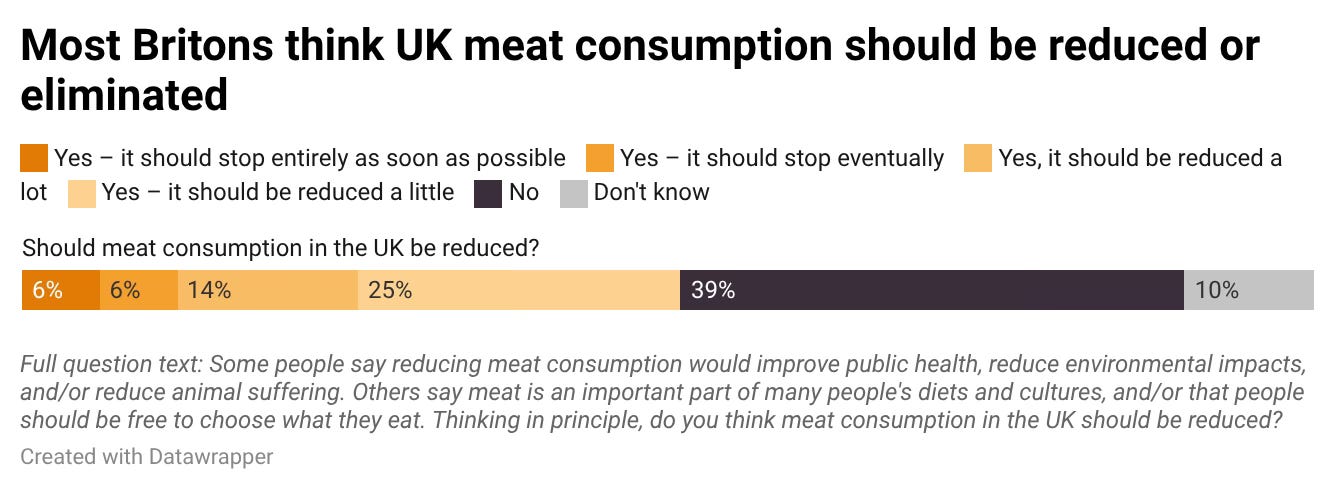
The research also found that six in ten meat-eating Brits are open to, or have already started, reducing eating meat.
6. Age affects how people perceive the issue and the solutions.
There was one finding from the research that particularly surprised us. Younger adults (18–24) are the most likely to support reducing meat, but the least likely to say factory farming is always morally wrong. The two priorities swap places somewhere around 40–45, with moral opposition to factory farming overtaking the appetite for eating less meat.
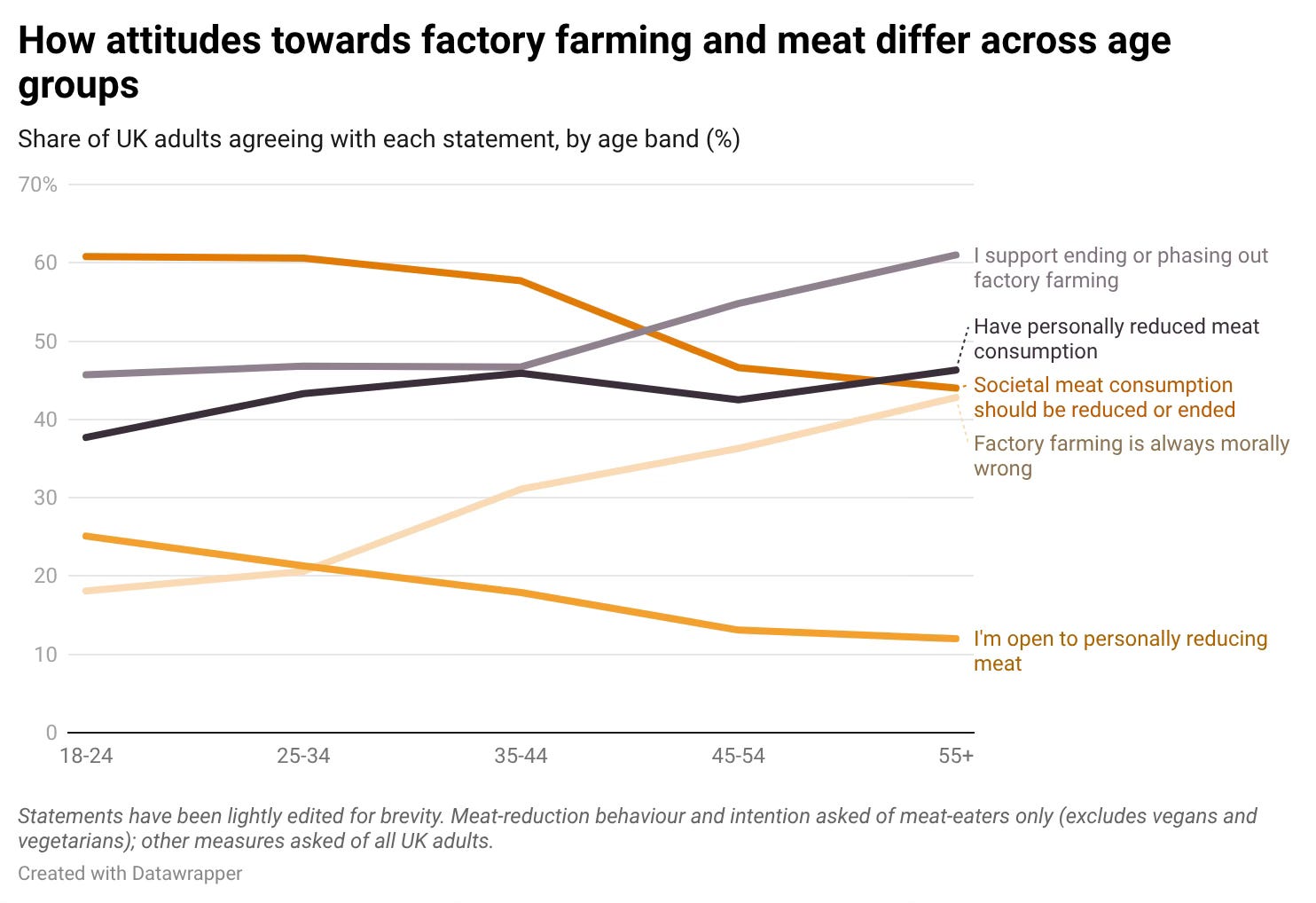
A lot can be read into this, and we have some hypotheses that we plan to test in the future, but the data points to an important opportunity:
Building durable moral opposition among younger people – not just dietary intention – may matter more for our movement’s long-term goals.
7. Many Brits want an end to slaughtering animals.
Over a fifth of British adults (21% ) want the slaughter of animals to end, not just factory farming phased out or reduced. This is in line with other recent UK research. That’s an encouraging base for us to build from: a fifth of the country isn’t just uneasy about how animals are farmed, but are ready for a world where killing animals for food stops entirely.
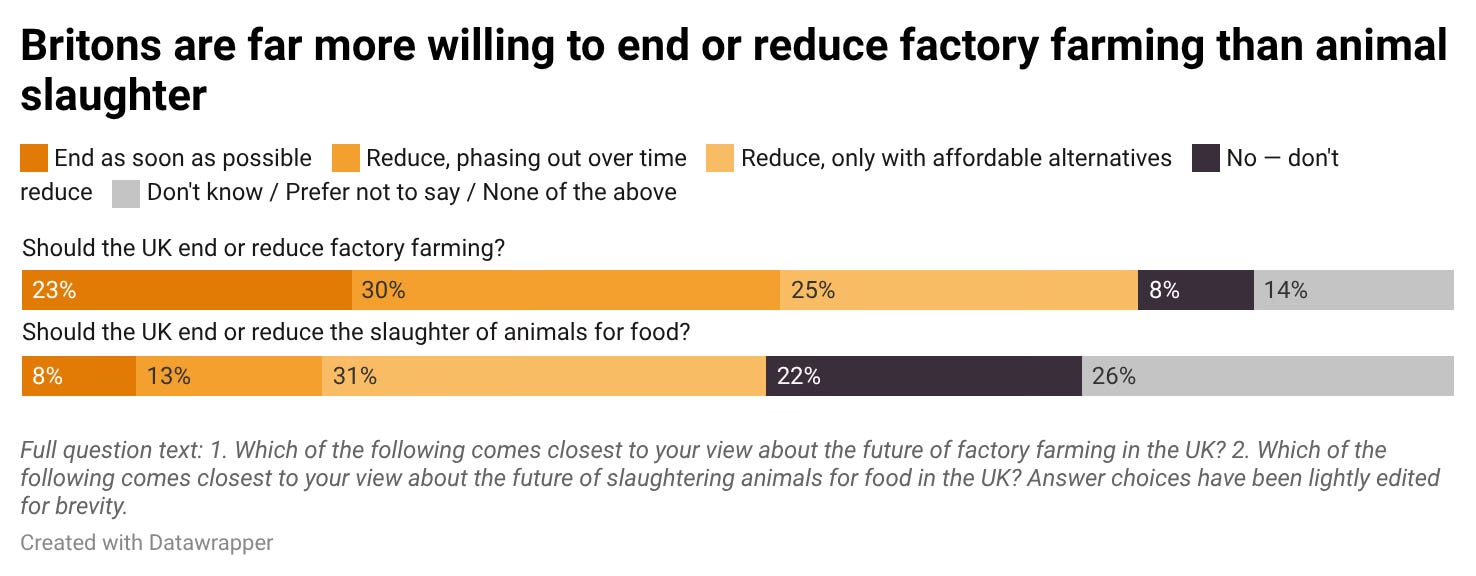
But 21% is still a minority. Most people who want factory farming ended are not (yet) calling for an end to farming animals altogether.
For many of us in the animal freedom movement, campaigning to end factory farming when animals would continue to be farmed and killed can feel like settling for far less than animals deserve. And there is a big question around how a campaign like this can be effectively communicated in a way that activates a freedom frame (that animal freedom benefits all of us) rather than a welfare frame (that it’s OK to farm and kill animals if done in an ‘ethical’ way). We will be doing research to try to answer this question, but for now, the data is clear: an ask built around ending all farming of animals wouldn’t garner majority support right now, and pushing it risks framing our movement as extreme – anti-farmer, out of step with the public – at a moment when a genuine majority is within reach on ending factory farming.
The animal freedom movement can be radical and practical at the same time.
Radical, because we’re calling for an end to factory farming – not improvements, reduction, or better monitoring. Practical, because it’s an ask the majority of the public can get behind, on a timescale institutions could viably deliver. (Particularly in a context where the effects of the climate crisis are being experienced in more countries globally.) This doesn’t mean retreating from the bigger goal of animal freedom – it means moving the moral baseline for everything that can come next, because without ending factory farming first, we stand little chance of achieving animal freedom later.
At Project Phoenix, we believe the bigger vision should never get lost along the way. The 21% who already want slaughter to end are proof that it’s not a fringe position – it can resonate deeply with the portion of the public already further along their journey, and for some it can be the nudge that shifts them further still. What is unlikely to work is broadcasting a bold freedom message to everyone at once. Farming animals is so embedded in the status quo that a call to end all of it can read as upending everyday life for people who aren’t ready yet. Mass-audience communications are likely strongest anchored on ending factory farming; the fuller vision can grow in the spaces where audiences are already more open to receiving it.
8. Having bolder demands could be more effective.
This is only one study (although it does build upon many other studies). And there is still much more to research. But we believe these findings show it could be more effective to be bolder in our demands when it comes to factory farming. The moral opposition is already there. The appetite for ending factory farming – not reducing or improving it – is already a majority. And the willingness to do it within a definite timeframe is deliverable by the institutions we already have, if enough pressure is applied.
What’s missing is partly factual – people aren’t aware of the scale or the mental suffering of animals trapped in these systems – and partly imaginative. Our movement hasn’t yet done enough work to show people what a world beyond factory farming looks like, and why moving towards animal freedom is a better way of living together, not a loss. As well as communicating a compelling vision (another area we plan to research), the animal freedom movement can be pointing more to solutions, and a credible, appealing story of transition.
Societies have made huge changes before, on issues people once believed were impossible to shift. Yes, ending factory farming will be difficult and complex, given how embedded it is in the economy and how powerful the industry is. But we can only end factory farming if we build the public pressure to end it. This study shows the UK public seems ready for a larger leap than we might imagine. Perhaps the biggest question of all is: is our movement ready for the challenge of making that leap a reality?
To fund further research that can help the UK animal freedom movement and beyond, please consider supporting us.
You can dive into further insights in the one-page summary, the full report, read another take on the research in Björn Ólafsson’s blog, as well as hear Björn discussing the research on an Our Hen House podcast episode.
We’d love to know what you’re taking away from this research, and what you think Project Phoenix should be researching next. We’d also love to hear about relevant research you’ve read, studies you’ve been involved with, or insights you have from campaigning to end factory farming. Let’s keep this conversation going…
Excellent news to hear about how many people support an end to factory farming! Perhaps I am not ambitious enough, but I have trouble imagining a path to actually ending factory farming anywhere by 2040. Partially, I worry about how the support would do in the face of concerted factory farm lobbying and what happens when people realize their food will become significantly more expensive. I'm curious to see how your strategy and groups like project slingshot lay out milestones to convert this public support into meaningful action.